Choose crops from the meals you actually make
A seed list is not a garden plan. Start with meals, frequency, storage, light, and time, then choose a short list that can survive an ordinary busy week.
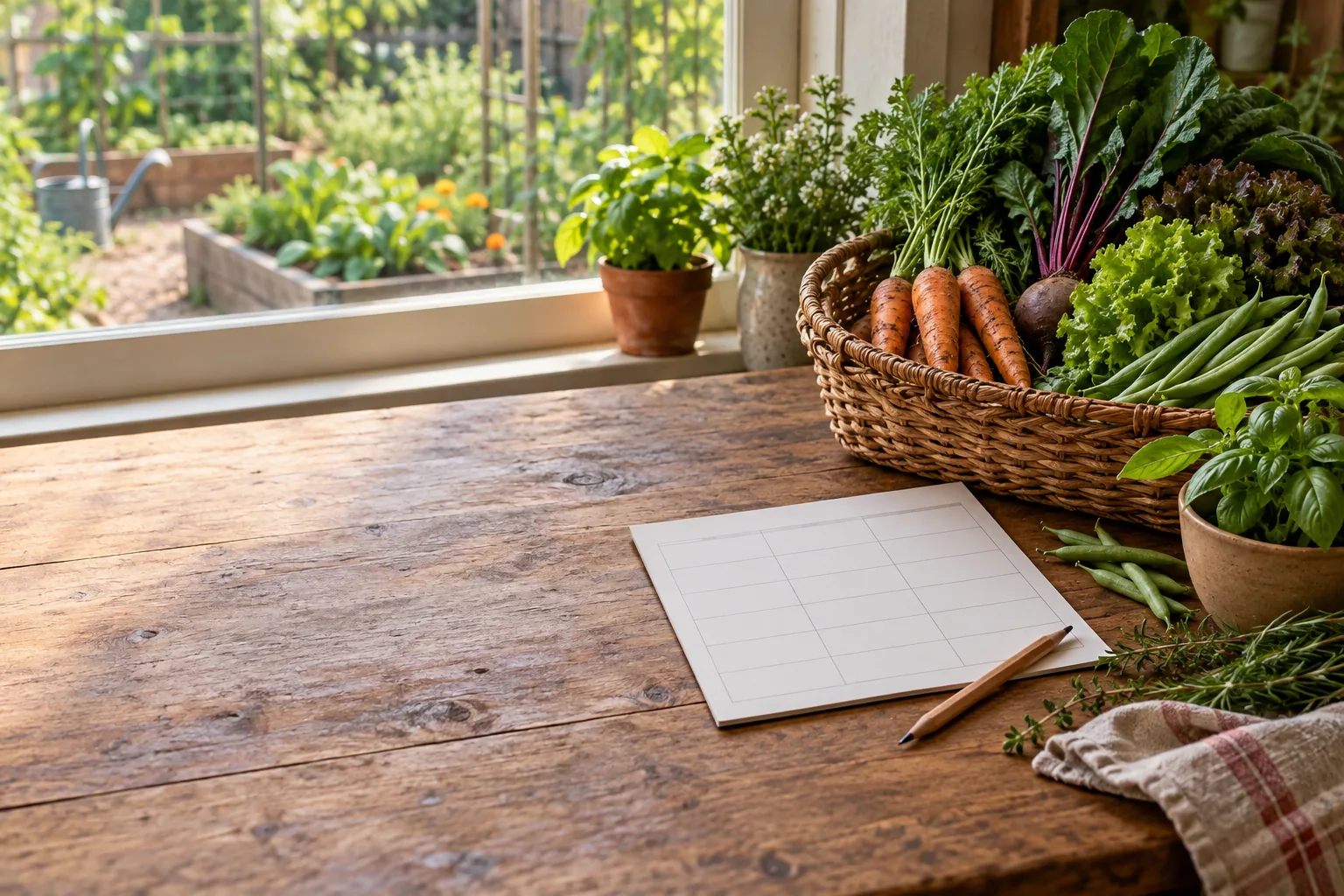
The crop filter
| Question | Keep the crop when | Cut it when |
|---|---|---|
| Will we use it often? | It appears in meals, snacks, or a repeatable preserving habit. | The only plan is to find a use after harvesting. |
| Does the site suit it? | Light, water, season, soil, and support are available. | A basic requirement is missing and cannot be changed safely. |
| Can we handle the harvest? | The quantity and timing fit the household and equipment. | A glut would be likely and no storage route exists. |
Build a five-crop first pass
- Write five meals or uses that recur in the household.
- Match each use to one crop that suits the site.
- Add one quick crop and one backup crop, not five more experiments.
- Assign a container, bed, watering route, and harvest window to each choice.
- Review the list after one season using what was eaten, wasted, or difficult to maintain.
Do not confuse novelty with value
A crop can be interesting and still be the wrong choice for this space. Keep a short “later” list so curiosity does not crowd out the food the household already knows how to use.
Turn a meal into a planting brief
Write the meal first, then break it into a crop, a harvest window, and a realistic quantity. “More vegetables” is too vague to plan. “Herbs for two suppers a week from May to September” gives you a use, a rhythm, and a reason to stop.
| Meal brief | Planting decision | Harvest check |
|---|---|---|
| Fresh garnish or salad | Prefer a small, repeatable sowing rather than one large bed. | Can it be picked in the amount used that week? |
| Cooked side dish | Choose one dependable crop and one replacement. | Will the crop mature while the kitchen can use it? |
| Preserving or freezing | Plan equipment, batch size, and processing time before sowing. | Is there a safe route for the whole batch? |
Example: a small household plan
A household that uses herbs, salad leaves, carrots, and beans could give each crop a different job: herbs for frequent picking, salad leaves for succession sowing, carrots for a slower dependable harvest, and beans only if the household will eat or freeze the quantity. The point is not to grow every category. It is to make every occupied square metre answer a real use.
What to record after the season
- How often the crop was actually eaten.
- How much was lost to bolting, pests, weather, or timing.
- How much labour watering, tying, thinning, or harvesting required.
- Whether the crop displaced something more useful.
Use those notes to adjust next year’s list. A crop that failed once may deserve another trial if the failure was timing; a crop that was healthy but never used should usually lose its space.
For the next planning step, compare this filter with the small-garden space map and the succession-sowing tracker.
Keep a deliberate “not this year” list
A crop that fails the meal, site, or time test does not need to disappear forever. Put it on a separate list with the missing condition: more sun, a freezer, a larger support, or a different season. This preserves curiosity without allowing it to crowd out the crops that feed the household now. Review that list only after the main plan is assigned space, water, and a harvest use.
Sources: RHS planning a vegetable garden and RHS growing food for household use.